
Private Chauffeur or Taxi: Compare Fares, Service and Comfort
Choosing a private chauffeur vs taxi is less about the journey itself and more about how you want it arranged. A private chauffeur is a professional driver booked in advance, usually with the vehicle and fare agreed before travel. Taxis can generally be hailed, picked up at a rank or booked by phone or app, with fares commonly calculated by a meter. One offers planned, private travel; the other provides flexible point-to-point transport.
Both can get you where you need to go. The right choice depends on whether immediate availability or a planned arrival matters most, how predictable you need the fare to be, and the comfort and passenger capacity your trip calls for.
This guide compares booking, fares, vehicles, passenger capacity and business travel across taxis, private chauffeur services and app-based rides. You’ll see where each option fits, from a spontaneous city trip to an airport transfer or a carefully scheduled corporate journey, so you can choose with greater clarity and ease.
Key Takeaways
- Choose a taxi for flexible, on-demand trips; pre-book a chauffeur when a planned pickup and private travel better suit your schedule.
- Compare how fares are set: taxi costs commonly depend on the meter, while chauffeur journeys are generally priced by agreement before travel.
- Consider the driver’s role as well as the vehicle. Chauffeur services place greater emphasis on passenger care and a composed arrival.
- For business travel, weigh privacy, punctuality and the ability to plan journeys around a demanding itinerary.
- Match the vehicle to your group size and comfort needs, then use the article’s decision guide to choose the right fit for each trip.
On-demand taxis versus pre-booked chauffeur services
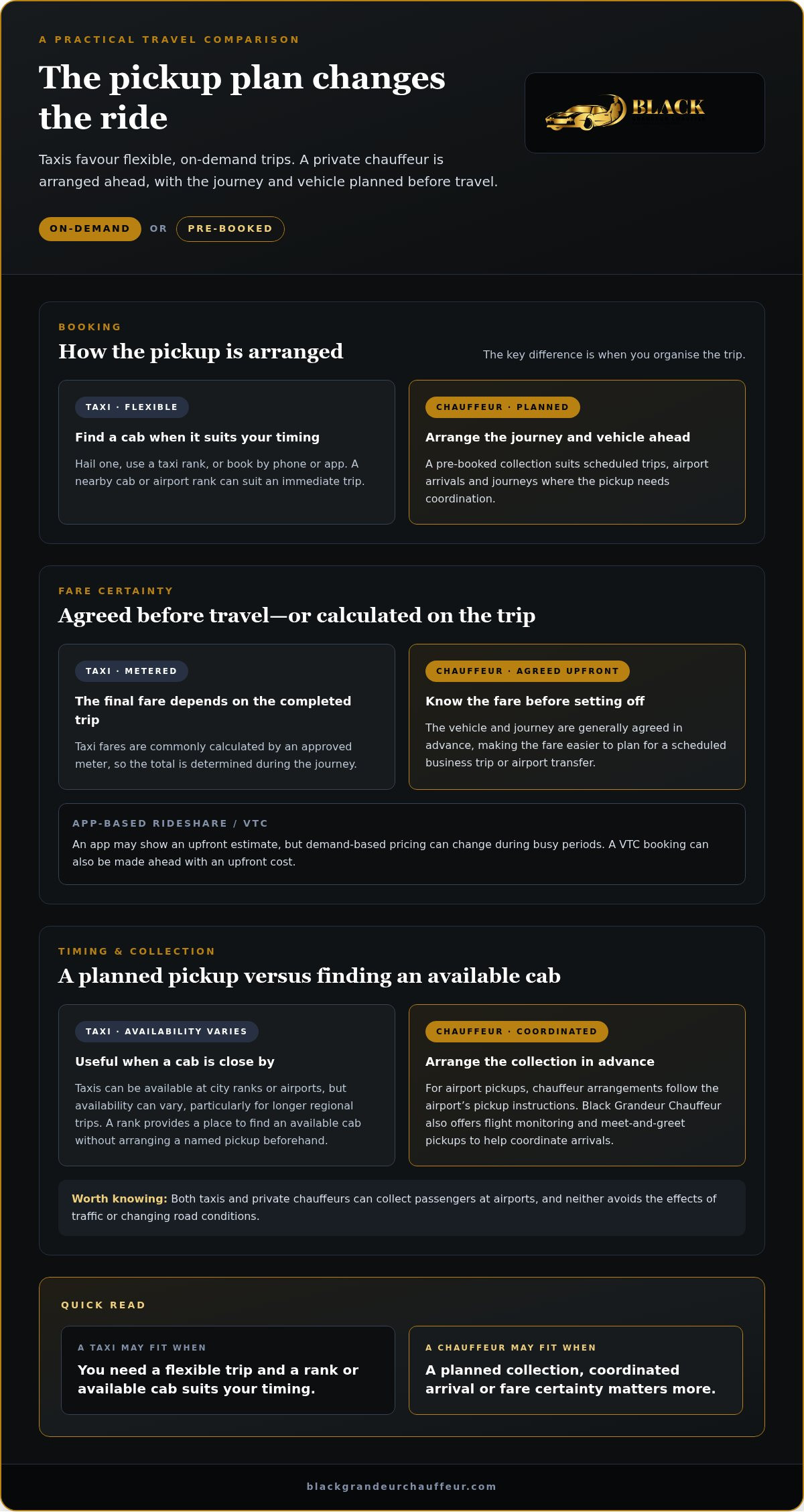
Booking method shapes the pickup, fare certainty and level of planning. In Australia, taxis suit immediate trips, while chauffeur services are arranged in advance.
Upfront chauffeur pricing
A chauffeur booking is arranged in advance, with the vehicle and journey agreed before travel. The fare is generally known upfront, making it easier to plan an airport transfer or a scheduled business trip. A VTC booking can also be made ahead, with an upfront cost.
Taxi fares are commonly calculated by an approved meter, so the final amount depends on the completed trip. App-based rideshare services may show an estimate, but demand-based pricing can change during busy periods. The key difference is whether the fare is agreed before setting off or calculated during the journey.
Reliability and punctuality
For a pickup where timing matters, pre-booking a professional chauffeur lets you arrange the journey in advance. It creates a planned collection rather than relying on a taxi being available at the moment you need one. Taxis can be immediately available at city ranks or airports, but availability can vary, particularly for longer regional trips.
Are private chauffeurs or taxis more reliable and punctual in Australia? A pre-booked chauffeur is generally better suited to a planned pickup; a taxi can be convenient when one is available at a nearby rank. Neither option avoids the effects of traffic or changing road conditions.
Can taxis and private chauffeurs use airport pickup zones in Australia? Both can collect passengers at airports, but pickup arrangements depend on the airport. Taxis use designated ranks, while chauffeur pickups are arranged in advance and must follow the airport’s pickup instructions.
Black Grandeur Chauffeur services also offer flight monitoring and meet-and-greet pickups, including for major airport travel. These features can help coordinate an arrival when a flight time changes or you need assistance finding your driver. A taxi rank, by contrast, provides a place to find an available cab without arranging a named pickup beforehand.
| Option | Booking | Fare approach | Pickup and planning |
|---|---|---|---|
| Taxi | Rank, street hail, phone or app | Usually metered; total fare depends on the completed trip | Useful when a cab is available nearby or at an airport rank |
| Private chauffeur | Pre-booked with journey and vehicle arranged ahead | Generally agreed upfront | Suited to planned collections, airport arrivals and scheduled trips |
| VTC or rideshare | Booked through an app | Upfront estimate, with demand-based pricing that may change | App booking offers a digital way to arrange a ride |
Choose a taxi for a flexible trip when a rank or available cab suits your timing; book Black Grandeur Chauffeur when a coordinated pickup and fare certainty matter more.
Chauffeur vs Taxi: What's the Real Difference?
In Australia, the difference is not simply the vehicle or destination. A chauffeur’s role includes planned passenger care, while a taxi driver’s central task is providing a taxi journey.
Chauffeur and taxi-driver roles
A professional chauffeur is engaged to drive and attend to the passenger’s journey. This can include opening doors, helping with bags and providing a composed arrival for corporate travel. A taxi driver focuses on taking passengers to their destination, whether the journey begins at a rank or follows a booking. Both roles involve transporting passengers, but the chauffeur role places greater emphasis on service during the trip.
Vehicles, pricing and comfort
Taxi vehicles often display visible identification, while chauffeur cars are usually unmarked or discreetly identified. Taxi choice can depend on what is available; chauffeur services can offer a range of vehicles, including luxury saloons and limousines. Fare structures differ too: taxis commonly use a meter, while chauffeur journeys are generally priced for the booked service.
Comfort also depends on the journey’s purpose. A taxi may suit a direct trip, while a private vehicle can offer a quieter, more private setting for a business conversation or formal arrival. For example, someone travelling to a meeting may value the chauffeur’s planned service as well as the car itself.
Attire and professionalism
Chauffeurs are commonly presented in formal attire, such as a suit and tie, while taxi and rideshare drivers do not have a specific dress requirement. A polished appearance forms part of the chauffeur service, alongside courtesies such as helping with bags. Taxi journeys generally prioritise the trip itself rather than a formal arrival experience.
Training can differ by role. Chauffeur training may cover the vehicle, advanced driving and first aid, alongside passenger-service skills. The distinction is practical: a chauffeur is trained to provide service as well as drive, while a driver’s training centres on driving. Standards can still vary between operators, so the role alone does not describe every individual’s experience.
Licensing arrangements also depend on the Australian jurisdiction and vehicle category. Taxi licensing may involve separate licences for the driver and vehicle, while private-hire requirements can differ. Common taxi licensing checks include criminal-record and right-to-work checks, medical assessments and, in some places, local-knowledge tests. These are regulatory processes, not a guarantee of a particular level of comfort or service.
For a scheduled meeting, compare the vehicle, passenger-care expectations and fare structure, not just the route. A taxi can be practical for a direct, everyday journey; a chauffeur is better aligned with a planned arrival and attentive service. For business journeys where a considered experience matters, explore corporate executive travel.
Business and corporate travel
For work travel, weigh the schedule, passenger needs and purpose of the arrival. The private chauffeur vs taxi decision for business often turns on how precisely the journey must fit the day. A booked chauffeur can suit planned meetings and events; a taxi may suit a direct trip when flexibility matters more.
Which is better for airport transfers, business travel or special occasions in Australia? A pre-booked chauffeur is generally better suited to airport transfers, corporate itineraries and formal occasions because the journey can be organised around the arrival. A taxi can be practical for a straightforward trip when a rank pickup or immediate availability fits the plan.
For corporate travel, map the route between the office, airport and meeting venue before choosing. A chauffeur journey can be arranged around several stops, giving passengers a private setting between appointments. A taxi is often a simpler point-to-point option. Traffic can affect either trip, so allow a buffer before an important meeting or flight.
For an airport transfer, provide the flight details, destination and luggage needs during booking. This helps plan the collection, whether the traveller is heading to a hotel or continuing to a meeting. A chauffeur service can arrange a planned pickup and meet-and-greet. A taxi rank provides access to available cabs. Choose based on whether a coordinated arrival or direct connection matters more.
Special occasions bring different priorities. For a wedding, gala or client event, a premium vehicle and composed arrival may matter as much as reaching the venue. For an informal dinner or unplanned evening trip, a taxi may offer more flexibility. Consider the event’s formality, the group travelling and the expected arrival time.
Longer journeys also benefit from planning. A Sydney Airport trip to Newcastle or the Central Coast is described as a two-hour route. Consider passenger comfort, luggage and planned stops. A chauffeur may suit travellers who value privacy and a defined itinerary. A taxi may work when available and when a direct journey meets the need.
Families travelling in Queensland should account for child-restraint requirements. A Queensland taxi may carry a child without a child restraint under an exemption, while private vehicles are subject to different child-restraint rules. This distinction matters when arranging an airport transfer with children. Include the child’s travel needs in the transport plan from the outset.
A private chauffeur vs taxi comparison for a workday or event should begin with practical details. Note the pickup point, destination, meeting time, passenger count and luggage. Add child-restraint needs for Queensland travel, then factor in traffic and the formality of the arrival. These details clarify whether a taxi’s flexibility or a chauffeur’s planned service better supports the day.
Vehicle quality and passenger capacity
Vehicle choice affects comfort, luggage space and how passengers arrive. Compare the available vehicle type with your group’s needs before booking a transfer.
Passenger capacity
Capacity means more than counting seats. A Mercedes V-Class is listed as suitable for up to seven passengers, while chauffeur fleets may also include sedans, SUVs, vans, minibuses and larger vehicles. Taxi capacity depends on the vehicle available, so a group may need more than one car.
Count every passenger, then consider luggage and any mobility needs. A vehicle with enough seats may still leave limited room for suitcases, especially on an airport transfer. For example, a group travelling with several large bags should consider both passenger capacity and cargo space, rather than choosing by seat count alone.
Vehicle comfort and selection
Chauffeur services can offer a choice of vehicle types, including luxury saloons and limousines. Taxi vehicles can vary in quality and passenger comfort according to availability. That difference matters on a longer journey, when cabin space and a quieter setting may be more valuable than on a short trip.
Wheelchair access is another practical consideration. Taxi vehicles may have accessibility requirements, while private-hire services can use a broader range of vehicle types. For a passenger using a mobility aid, the right choice depends on the vehicle’s access and space, not simply its exterior appearance.
Luxury is not a single specification. A sedan may suit an individual traveller or a small party, while a van or limousine can accommodate a larger group. Match the vehicle to the trip: a formal arrival may call for a luxury car, while a family airport transfer may need room for passengers and luggage.
Vehicle availability shapes taxi selection at pickup. By contrast, a pre-booked chauffeur journey lets you consider the vehicle alongside the group size and itinerary. This can make planning easier when several passengers share a transfer or the arrival has a particular tone.
Use this simple sequence: count passengers, estimate luggage, note any access needs, then choose the vehicle category. A Mercedes V-Class provides a concrete capacity reference at up to seven passengers, but luggage and comfort still affect whether that option suits the journey.
For one or two passengers on a short trip, an available taxi may be practical. For a group, formal occasion or transfer with substantial luggage, compare the vehicle’s capacity and comfort before deciding. The best fit accommodates everyone and their belongings without compromising the purpose of the journey.
Fixed fares versus metered fares and demand pricing
Fare structure affects how a journey fits a budget. Compare how the cost is calculated, when it becomes clear and what can change it.
Fixed chauffeur fares
A chauffeur fare is generally agreed before travel, based on the booked journey and service. That gives passengers a clearer amount to plan around for an airport pickup, corporate itinerary or event. The agreed fare contrasts with a taxi meter, which calculates the trip as it happens. Before confirming, check what the quoted fare covers, such as planned stops or waiting arrangements.
Metered taxi fares
A taxi meter calculates the fare based on the journey, including distance travelled and trip duration. Time of day or night can also affect the amount, alongside applicable extras for items or services such as luggage, animals or child seats. A short route through traffic may therefore cost differently from the same distance in lighter traffic. In Western Australia, maximum metered taxi fares are regulated for rank and hail journeys.
Demand-based fares
Rideshare fares use demand-based pricing and can change frequently. A busy period, event or high volume of requests can affect the fare shown in an app before booking. That differs from a chauffeur fare agreed in advance, which provides greater cost certainty for a planned pickup. Compare the displayed estimate with the final fare rules, particularly when travel coincides with a major event.
Chauffeur and taxi costs
How much does a private chauffeur cost compared with a taxi in Australia? A private chauffeur fare depends on the journey and is provided after a quote request; distance, duration, vehicle choice, stops and pickup timing shape the quote. Taxi costs depend on the metered journey, including its duration and any applicable extras. The more predictable option depends on whether you value an agreed fare or payment based on the completed trip.
For a corporate journey with several stops, compare the whole itinerary rather than only the first pickup. A chauffeur quote can account for the planned route and vehicle, while separate taxi trips are calculated individually. For a simple point-to-point trip, the meter means the taxi fare depends on the actual journey. For an event departure during a busy period, rideshare demand pricing may change before booking.
Before choosing, note the pickup location, destination, planned stops and vehicle needs. Then compare the chauffeur quote with the taxi’s metered approach and consider how traffic could affect trip duration. For a planned corporate journey, request a chauffeur quote based on the itinerary.
Black Grandeur Chauffeur: Corporate Executive Excellence
Black Grandeur Chauffeur offers Corporate Executive Excellence for business travel where a planned journey and professional arrival matter. For private travel, VIP Private is another option; Airport suits travellers arranging a transfer. These offerings help match the service to the purpose of the trip rather than choosing transport by fare structure alone.
For group occasions, consider the Stretch Limousine - 10 Seater or Stretch Limousine - 14 Seater. Select based on passenger numbers and the event, then organise the journey around its pickup and destination. For an individual business trip, Corporate Executive Excellence may be the more relevant fit.
Visit Black Grandeur Chauffeur’s website to explore the available services.
Choose the journey that suits what comes next
Let the purpose of your next trip guide the choice. A routine journey may call for a simple ride, while a significant arrival can benefit from a more considered arrangement. The private chauffeur versus taxi decision becomes clearer when you start with the experience you want at your destination, not only the distance you need to travel.
Before booking, consider what would make the journey feel complete: discretion for a business conversation, a composed arrival for a special occasion, or room for a group to travel together. Black Grandeur Chauffeur offers Corporate Executive Excellence, VIP Private and Stretch Limousine - 10 Seater, each suited to a different travel purpose.
Choose the service that best reflects your plans, then organise the journey around your priorities. Contact Black Grandeur Chauffeur to discuss your travel requirements. A thoughtful choice can make the next arrival feel calm, considered and entirely your own.
Frequently Asked Questions
What is a chauffeur?
A chauffeur is a professional driver engaged to transport passengers while providing considered personal service. The role may include helping with luggage, opening doors and coordinating a planned collection. For example, a traveller arriving with presentation materials for a meeting may value assistance from the vehicle to the venue. A taxi driver’s primary task is providing the journey, rather than delivering this broader passenger-service experience.
When should you choose a taxi, rideshare or chauffeur?
Choose a taxi for a direct trip when you can use a rank or find an available cab. Rideshare suits app-based bookings where you want to see a fare estimate and arrange digital payment. A chauffeur is a better fit for a planned occasion, a formal arrival or an itinerary needing a dedicated vehicle. Consider the pickup, passenger needs and purpose of travel before choosing.
Is a private chauffeur worth the extra cost?
A chauffeur may be worthwhile when privacy, advance planning and passenger care matter more than choosing the lowest-cost option. The price depends on the journey and is provided after a quote request; distance, duration, vehicle choice, stops and pickup timing affect it. For a short, uncomplicated trip, a taxi may better suit your needs. Consider what the service adds to your particular journey before deciding.
Why choose a chauffeur for Melbourne Airport transfers?
A pre-arranged chauffeur transfer can make an airport arrival more coordinated. Chauffeur bookings can include flight monitoring and meet-and-greet arrangements, helping align the pickup with the flight’s arrival. This can suit passengers carrying work equipment, travelling with family or continuing to a scheduled appointment. Share flight details and destination during booking so the pickup plan reflects the arrival.
What is the difference between a private chauffeur and a taxi in Australia?
A chauffeur journey is generally pre-booked and focuses on driving and passenger service; taxi travel is commonly available through ranks, street hails or bookings. Vehicles may also look different: taxis often display visible identification, while chauffeur cars are usually unmarked or discreetly identified. Licensing requirements vary between Australian jurisdictions, and taxi and private-hire arrangements may have different rules for drivers and vehicles.
How are chauffeur and taxi fares calculated in Australia?
Chauffeur fares are generally agreed for the booked service, while a taxi meter calculates the fare during the trip. Taxi costs may reflect distance, journey duration, time of day or night and applicable extras. When comparing a direct airport trip, consider whether traffic could lengthen a metered journey. Rideshare fares are demand-based and may change during busy periods.
What vehicle types and service levels do chauffeurs and taxis offer?
Taxi passengers generally travel in the cab available at pickup, while chauffeur services may offer a choice of sedans, SUVs, vans, minibuses and limousines. A Mercedes V-Class is listed as suitable for up to seven passengers. Black Grandeur Chauffeur’s executive fleet includes the Mercedes S-Class, BMW 7 Series and Audi A8. Match vehicle choice to passenger numbers, luggage and the formality of the occasion.
How do you book a private chauffeur or taxi in Australia?
To book a chauffeur, contact Black Grandeur Chauffeur, select a vehicle and share your journey details and any additional requirements. Review the itinerary provided before travel, then use it to guide the pickup on the day. For a taxi, arrange a cab by phone or app, hail one where permitted, or join a taxi rank. For either option, provide a clear pickup point and destination.